
Marketing and consumer researchers need to employ a dose of curiosity for understanding, more closely and deeply, groups or communities of consumers that are less familiar and more different from them. It can be sought by observation of individuals from the group of interest, listening to and talking with them, and possibly interacting with them in more engaging ways. Researchers draw in such missions more frequently on the perspective of anthropology on understanding the Other, and study by adopting techniques from its methodological field of ethnography.
In borrowing from anthropology, marketing and consumer researchers aim to understand the human relationships among people (‘self-other’) in other cultures, extended to encompass their different or distinctive sets of values, perceptions and viewpoints, lifestyles and varied behaviours (e.g., customs & rituals, work & leisure activities). Ethnography is concerned with observing, capturing and describing those relationships, conceptions, and behaviours.
However, the scope of topics and groups that can be studied with ethnographic methods has been quite expanded over the years (without requiring researchers to travel to faraway countries). Researchers may study, for example, first-generation immigrants and next-generation natives whose families come from communities of different ethnic origins keeping their old traditions (e.g., cuisine, family life, celebrations and holidays). Yet, ethnography may also be applied to gain closer familiarity with consumers of groups with perceptions, approach to things in their lives, and behaviours that are more characteristic of them (e.g., children and youth, academic students, pensioners & elderly). Furthermore, the methods of ethnographic description may be suitable to explore groups with special interests and hobbies (e.g., computer gamers, cooking, sports, arts). With respect to marketing and consumer behaviour, the research would entail greater focus on shopping, consumption and usage activities and experiences of consumers.
Historically, ethnographers have mostly kept a record of their observations and impressions by writing notes. In more recent times the use of visual images in ethnographic research has increased, including still photographs and video films. The use of imagery in recording observed events started already in the early 20th century, but it truly gained traction after video footage could be conjoined with synchronous soundtrack on portable cameras, as photography and video became digital, and cameras were made even more lightweight and easier to handle around. Visual anthropology or ethnography is applied nowadays much more frequently, nearly integrated in this field. Nevertheless, researchers are called to use images not just for illustrating and corroborating their text notes but in making visual imagery an intrinsic part of the observation process [1].
Two main forms of observation have long been practised by ethnographers: participant observation and non-participant observation. In participant observation the researcher joins and takes more active part in the activities performed by the individuals (subjects) he or she is studying while observing them, whereas in non-participant observation the researcher is standing aside and only observes the individuals studied without intervening in their activities. Participant observation is the stream of observation more accepted among ethnographers, allowing the observer to mingle and interact with the individuals while observing them. The possibility of interfering and influencing the behaviour of observed individuals has to be balanced against the closer and more intimate understanding that can be gained from participation.
The introduction of still photography and video into ethnographic research creates new possibilities of method varieties that enrich the existing streams in observation or adds to them. At the same time, this also raises new issues and concerns, functional and ethical, to account for. We may find, for example, new aspects to consider in participant and non-participant observation, evolution of participant observation research into more collaborative forms of study, and the addition of photos and videos generated by the individuals studied [1]. With respect specifically to creating video films, three major forms of videography have been identified: researcher-driven videography (i.e., video filmed by researchers), autovideography (i.e., video filmed by participating individuals studied), and collaborative videography (i.e., cooperation in making video films and discussion about them between researchers and some of the individuals taking part in the study) [2]. Additionally, observation and photo-taking or video-making may be followed by interviews with the individuals participating in the study to glean deeper understanding through self-explanation of their behaviours, elaboration of their thoughts and feelings, and their own interpretation of visual images, researcher-driven or their own (i.e., by photo elicitation).
Let us consider some relevant issues. When the observer also participates in the activity of a group, while holding a photo or video camera taken into the event, he or she may get closer to individuals and shoot from different angles to capture details of the activity and visual cues from the individuals. However, this may be considered too obtrusive by some individuals in the group. Alternately, the participant observer may position a video camera on a tripod from distance beforehand to automatically film, but with less control over the content captured. On the other hand, if the researcher is not participating, he or she may position a camera on a tripod from distance and shoot photos or video from there. In either case, keeping the camera away from the centre of the scene may be considered less obtrusive by individuals, yet perceived as infringing on their privacy. Hence, researchers have to trade-off between reducing obtrusion and protecting privacy [1].
Whether the observer-photographer stays by the camera to operate it or tries to stay further away to be less visible, the camera often remains visible and cannot be ignored by the participating individuals in the study. It may be futile to assume that capturing the event with a camera can be truly objective. Actually, the very presence of the observer as a witness defies objectivity. It is more appropriate to approach the process as subjective. It has been suggested, therefore, that disturbance created by a witnessing observer, with or without a camera, should not be treated as an epistemological obstacle but rather as an “infinitely rich source of knowledge” [cf. 1].
Individuals participating in a study are invited more frequently to generate and submit their own photos and videos from their everyday lives, and particular activities of interest (e.g., at home, at school, in social events). The participants can generate the visual imagery in the more natural settings and situations in their lives, and it does not require researchers to be present. Indeed, the participants have control over content and may not capture scenes that could be of interest to the researchers (who possibly do not need to know for the sake of privacy), but it would reflect what is more important to the individuals (consumers), which should be the more relevant and valuable information for the research. These images can be utilisied as complementary to images created by the researcher, and especially be the basis for photo-elicitation at a later stage of the study. However, more studies appear to be carried out in recent years on the basis of the participating individuals’ own photos or videos, relying often on cameras of advanced smartphones used by many consumers.
Another development, which deals with the sensitivities of study participants being photographed or filmed by a researcher, is the conduct of observation and visual documentation in collaboration. The participant observer can bring a hand-held camera to the centre of the scene and make it an active player in the event. Moreover, the individuals studied are allowed and even invited to influence how and what photo images or videos are generated and react to the visual images viewed shortly after the action. Henceforth, researchers may benefit from richer and more authentic knowledge, whereby the visual image is used interactively in a subjective and reflexive way to understand the (sensory) experiences of the individuals (consumers) studied. Thus, the image becomes in itself a field of research [1].
Observation as a methodology for collecting data in research can be employed for different purposes. Not every application of an observation method can necessarily be classified as producing ethnographic descriptions. It depends on the context and types of information the researcher aims to learn about, as not every observation is outset from the perspective of understanding the Other. For example, observation techniques are used for studying and understanding processes of decision making. When a researcher walks along with a shopper in a store, observes, possibly whilst filming with a camera (handheld or head-mounted), and probes the shopper for explanation of actions and choices, is it truly about understanding the Other? The anthropological perspective is less relevant here, although the disciplines do share research techniques.
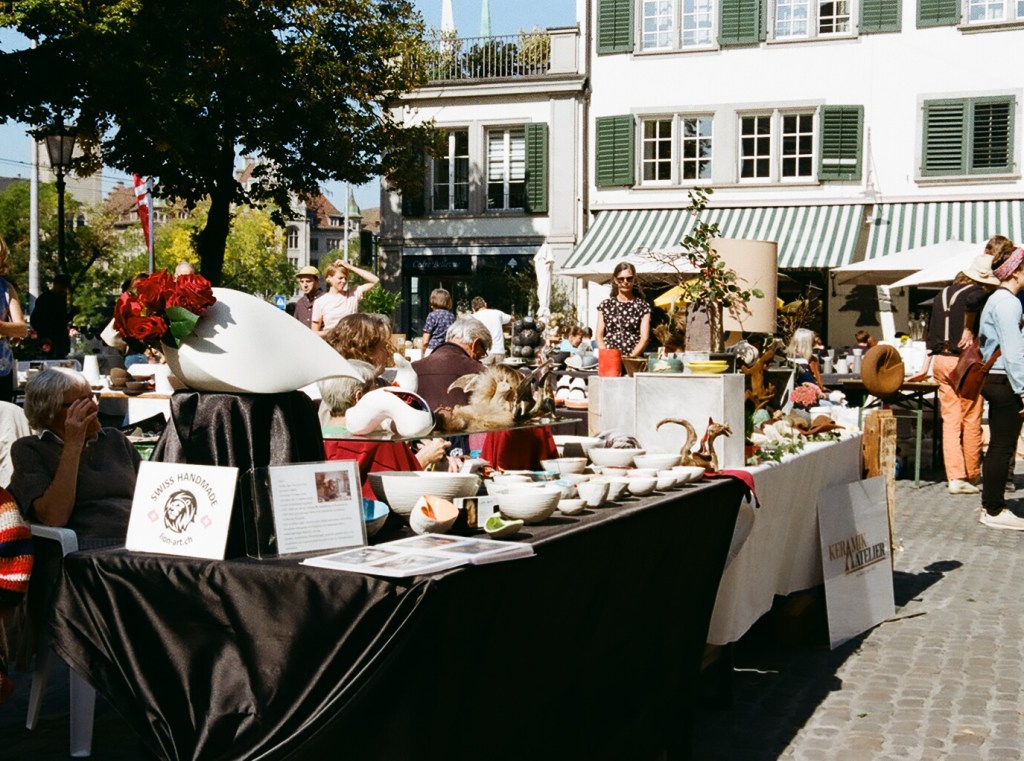
Additionally, a form of participant observation is not quite suitable in a store like a supermarket. Researchers may utilise cameras that are either visible (e.g., on a tripod in a specific area of the store) or concealed (which raises an even greater ethical problem). In a variety of situations, locations and events researchers may apply non-participant, participant, and furthermore collaborative forms of observation for marketing and consumer research purposes that can be viewed as ethnographic descriptions (see aspects suggested at the beginning of this article): family at the dinner table on weekend or holiday; open-air markets (e.g., food, handcraft and artwork); food festivals; exhibitions (e.g., art, trade); music and sports events. The consumers may contribute their own photos and videos from these occasions. Hence, these are research opportunities where observation techniques adopted from ethnography (anthropological research) are relevant and beneficial to marketing and consumer research.
In a webinar of Greenbook (MR association) with Bulbshare (MR firm), Thomas Visby Snitker, Head of Research at LEGO, shares lessons and insights from his experience in implementing ethnographic studies with children [3]. These are chosen highlights:
- Doing research with children involves special sensitivities and ethical concerns. When using a camera in the room, the researcher needs not just to be granted the consent of children but also assure them about the purpose of the camera and verify their understanding. The camera could be distracting or intimidating for smaller children and hence special care is advised. It is also better to hold the study sessions in private homes or at school rather than in the company’s facility. Children have unique vulnerabilities that must be addressed.
- Observing children playing with the blocks, models and other toys of LEGO would seem most natural. Yet, it is not necessarily the focus and main part of sessions with the participating children. It could involve talking with the children and among themselves about a myriad of related subjects (e.g., other toys and games, films and TV programmes, decorations and wall drawings in their rooms). The children may be allowed to express themselves not only in words but also through drawing (especially when they have difficulty to talk about a subject or in finding the words to describe what they want and like to do). Eventually things come together, connect and add meaning.
- Children have their own language to which the researcher has to accommodate oneself. They may feel unsure or embarrassed, and often answer with “I don’t know”; the researcher has to find the way, without pressuring, to encourage them in expressing themselves whether in words or pictures. It is important especially with children to pay attention to visual cues such as body language (e.g., gestures, movements) and facial expressions.
Marketing and consumer researchers have much to benefit from adopting methods and observation practices from ethnography, in approach and technique. The insights that may be reached can enrich and broaden the understanding of consumers’ viewpoints, concerns, preferences and behaviours, and henceforth. Nevertheless, the researchers should keep in mind that observations yield ethnographic descriptions depending on the context and areas of knowledge covered in the study. When using a camera during observation, for still photos or video, study participants are likely to have sensitivities and precautions that researchers need to take into consideration. Approaches that allow for contribution of participants in generating visual images (still or video) and collaboration can mitigate such sensitivities while enhancing in new ways the knowledge gained. Visual ethnography can add power to observations, but it has to be handled with care.
References:
[1] The Contribution Made by Visual Anthropology to the Study of Consumption Behavior; Delphine Dion, 2007; Recherche et Applications en Marketing (English Edition), Vol. 22 (1), pp. 61-78 (available at ResearchGate.net)
[2] Videography in Marketing and Consumer Research; Russell W. Belk and Robert V. Kozinets, 2005; Quarterly Market Research: An International Journal, Vol. 8 (2), pp. 128-141
[3] “Fly on the Wall Research: The Power of Ethnographic Research for Deeper Consumer Immersions“, webinar of Greenbook with Bulbshare, hosting Thomas Visby Snitker of LEGO, 25 April 2024

 Consumer / Shopper / Customer Behaviour