
The landscape in food stores is gradually changing with a transition of retailers from printed price labels to digital price tags, formally known as electronic shelf labels (ESLs). When looking from some distance, shoppers may not notice the difference in appearance of the label, but the digital price display can have implications that shoppers may not truly be aware of. The transformation in pricing management and display goes beyond the visual landscape at a store’s shelves.
The electronic label is usually set within a flat plastic case. The display is based on e-paper or liquid crystal paper technology (referred to also as e-ink). One has to get pretty close to the label to discern that the ‘print’ is written in digital characters. The text may appear on a white or coloured background; e-paper typically supports the colours black, white, red and yellow for text & background. The use of two colours helps in creating contrast for emphasis and grabbing attention (e.g., a format of product name in white on red background area and price in black on white background area is most common). Price tags are available in different sizes, allowing for different amounts of detailed content that retailers wish to present (e.g., a line of product description, list & discount price offer). Hence, an ESL can be used to display not just price information but also some product information. More advanced ESLs on LCD or LED screens allow display of images (e.g., product package) and in more colours (note: usually in larger area size, and more expensive than e-paper ESLs). A quick Google search brings up a substantial number of providers of ESLs or digital price tags; for illustration see the offerings by Pricer of Sweden (notice the variable sizes and visual formats).
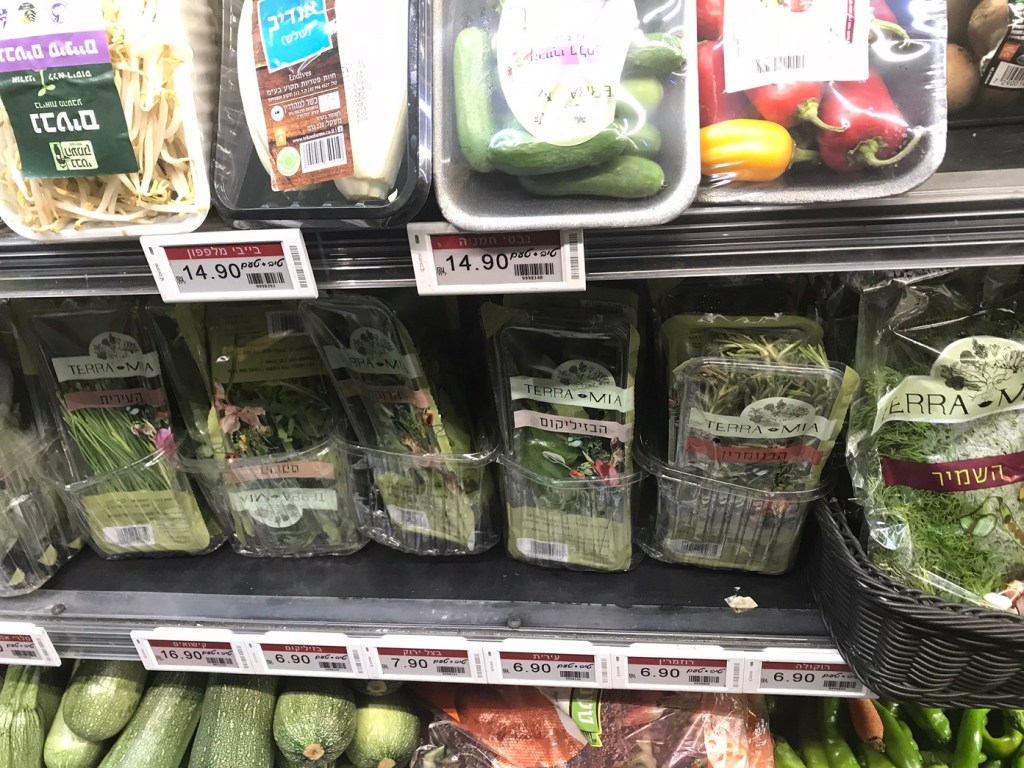
Digital price tags for vegetables in a food delicacy chain store (ESLs are installed only in the fruit & vegetables section of this store). Most labels include just product name, price, and bar code. There were also some larger labels (e.g., bananas) in a similar format. Labels with images such as packages remain in print on paper.
Digital price display is more often addressed by the media when used in food and grocery stores (e.g., supermarkets, convenience stores), perhaps because consumers visit them for shopping more frequently, and the issue seems more sensitive. However, digital price tags are suitable for use, and can already be found, in other types of stores such as electronics and home improvement. Furthermore, car showrooms have been moving in recent years to display vehicle and price information on a tablet-like screen which allows for more visual features (e.g., tables, colours, image of car model). Technical description of the car plus special features may be shown next to price offering, including list and special price offers and price supplements for optional add-on features. The more advanced and detailed display of product and price information is appropriate for stores of other large-size items (e.g., furniture, home electric appliances).
The crucial attribute of digital price tags, ‘behind-the-scenes’ for shoppers, is the ability to update prices for various products from a single main database source (e.g., as part of enterprise resource planning, ERP, system). Implementation of this capability is supported through wireless connectivity of the digital price tags with the ERP system as well as with points-of-sale (POS) in the store (cashier-operated or self-service check-out kiosks). Thus, all prices are conditioned to be the same at the shelf display as at the POSs, set from the price management information system. Price co-ordination is considered a primary advantage of the digital price display method for retailers. In addition, the ESL technology can also help retailers in inventory management, that is, in keeping track and signalling to store staff and shoppers alike about availability or shortages of product supply on the tags at the shelf display for every product (i.e., including availability in the selling area and in backroom storage).
Yet another key benefit of digital price display for retailers is the flexibility they gain in updating prices in real time and more frequently without requiring their staff to change price labels at the product shelves. This capability is part of applying a strategy of dynamic pricing with broader implications. First, it enhances competitive pricing by enabling retailers to respond more quickly to changes in the market (e.g., competitors’ prices, shifting trends in consumer tastes), or when retailers may pro-actively set prices in anticipating such market changes. Second, retailers may, at least technically, update prices according to short-term changes in demand (e.g., raise and drop prices during the day according to shopping patterns, whereby consumers arrive more in the morning before work and in late afternoon or evening after work, leaving the food store less busy around noon time). Third, at the consumer level, dynamic pricing combines with personalised pricing, that is, adapting prices to differences in preferences and willingness-to-pay among consumers, or the customer status of shoppers with the retailer (e.g., exclusive price offering for club members). This is apparently the most sensitive, critical aspect of the use of digital price tags for consumers — to which we will return later in the post.
Electronic shelf labels, beyond their use as price labels, offer some convenience benefits for consumers. First of all, it can give shoppers the assurance, as suggested above, that the price they see at the shelf is the same price they will be charged at the POS (per package unit or price per weight unit, e.g., 100g, 1kg). The ESL can aid shopping: the digital label may present some essential product information (e.g., ingredients or key features, health or allergy sensitivity warning); yet shoppers may access more product information easily on a mobile app of the retailer by Bluetooth connectivity with the ESL or by scanning a QR code on the price tag. Additionally, shoppers using the retailer’s app, usually club members, may also receive personalised price offerings automatically on their smartphone just by approaching the ESL for a given product (i.e., enabled by Bluetooth connection). The ESL or digital price tag can offer also a benefit of convenience to retailers by collecting data readily on behavioural patterns of shoppers in the store passing by shelf displays of products (e.g., by applying sensors embedded in tags and wireless Bluetooth connectivity — it is unclear how many retailers are actually using this option).
It seems that many retailers are still deliberating on the adoption of electronic shelf labels. The adoption is gradual or partial (e.g., selected product categories or stores) and is hardly encompassing across competing retailers in a sector. The balance of costs between print and digital labels may be delicate and non-conclusive. On the one hand, retailers can save on costs of printing new, updated paper labels and the replacement of labels by staff, since updated prices can be streamed to many digital price tags across a store, and staff can be ‘freed’ to other tasks. On the other hand, utilising hundreds of digital price tags for various products (SKUs) in a store (a cost of standard ESL around US$6 or UK£5) may amount to a considerable sum, and there is also likely a high initial set-up cost (cf. Allegro Logistics). According to another source, ESLs generally cost in the range of $5 for small tags (2″) to $20 for larger tags that allow for more information; large labels that support graphics may cost above $100 (Korona POS). The ESLs are operated on low-power and long-lasting batteries, but they may still have to be replaced once in a few years (ESL suppliers suggest that batteries may be refilled through the wireless network to last longer).
- Note: The efficiency of updating prices from a central information system introduces a vulnerability, as Allegro Logistics warns — there is a risk that an error in price updates for a single product or a group of products may propagate to all associated digital price labels in the retail business and may affect demand everywhere (e.g., setting a price too low or too high, or confusing prices between products). Furthermore, retailers have to be vigilant about data security in their main system and wireless network to prevent hacking that can disturb pricing display in the stores.
Besides shelf labels, stores may also make use of price stickers attached to packaged goods (e.g., on boxes, bags, bottles). Store staff have to go around with a sticker gun and attach a price tab to every package they put on a shelf. This method of price display is less frequent as it is hard to see why retailers would be interested in spending money and the time of staff on this activity, unless they are required to do so by regulation, essentially aimed to protect the interests of consumers. Proponents of those price stickers argue that they help consumers in keeping record of the prices of products they collect to their shopping basket and making comparisons. First, shoppers may verify that the price appearing on the package is the same as the price they are charged. Second, they may compare the attached price to similar products they hold at home without needing the bill.
Note that for some products selected from bulk display or served at a delicacy counter, the weight of the product actually bought varies and therefore a sticker is necessary and useful. However, for most packaged goods the price sticker is redundant, and it will be more so as the use of digital price tags spreads more widely. It is hardly efficient or even feasible to check against those price stickers while checking out with a human cashier or at a self-service kiosk — shoppers usually “catch” any mismatch after payment, and they may complain by comparing the price charged in the bill with the price stated on the shelf label (it is recommended that the shopper can get the bill before leaving the store). The use of ESLs by retailers should eliminate any gaps with POSs at cashiers and particularly self-service kiosks. At home, one can compare prices between purchase bills — it might be less convenient, but price stickers also tend to erode and fall off pretty fast. Shoppers have other reasonable ways to check, verify and compare prices, making it harder to justify the almost anachronistic method of price stickers. Bar codes will matter even more greatly in aligning prices between the electronic labels, POSs and main system.
Consumer advocates need to pay attention and dedicate their efforts for protecting consumers to the implications of applying dynamic pricing, tied with the utilisation of ESLs or digital price tags. That is where more potential problems or risks may arise for consumers-shoppers. The risk already well recognised is that ESLs and the way they can be updated would make it easier and quicker for retailers to raise prices. The technology would also enhance their capability to adjust prices in other sophisticated ways, varying prices across time periods (e.g., hours, days) and consumers (i.e., pesonalised or customised pricing according to personal characteristics, preferences and willingness-to-pay). The more enthusiastic supporters of ESL technology suggest that the prices on digital tags may be modified to suit shoppers with different predicted preferences approaching the shelf label (or at least have different offers transmitted to their apps). The implementation will be enabled by data-driven AI-based models and operational algorithms, whose utilisation is expected to increase. Therefore, utilising digital price display technology will require greater inspection and scrutiny of the actions of retailers. It is also likely to require regulation for setting certain limits on forms of dynamic pricing applied by retailers, such as the frequency of price updates (e.g., disallow surge pricing during the day) and scope of personalisation (e.g., ban or curtail unfair discrimination between consumers).
Application of digital price display, with all aspects of ESL technology related to it, creates new possibilities for retailers as well as consumers. It offers opportunities and benefits but also carries risks and vulnerabilities for both parties. There are potential benefits in efficiency, accuracy, convenience, and being better informed for making decisions. But in order to gain the best from those benefits, the field of ESLs will have to be carefully observed and scrutinised, and fair rules of the game be set.
More reading:
[1] “How Do Electronic Shelf Labels Work?”, Retail Technology Review (contributed by Adrian Stokes), 15 April 2024
[2] “Are Digital Price Tags Worth the Hype?”, Allegro Logistics
[3] “How Much Do Electronic Shelf Labels Cost?“, Korona POS

 Consumer / Shopper / Customer Behaviour
Fascinating! I never came across ESL’s. Can I find them in Israel?
LikeLike